Agra is treated as a stopover: in at dawn, Taj Mahal, out by evening. It is an understandable way to see the city and a poor one, because the Mughals built here for well over a century and the Taj Mahal is the last word in that story rather than the whole of it. Everything below is quieter than the Taj, and some of it is nearly empty.
In this article
Itimad-ud-Daulah: The Baby Taj
Start here, because it is the one that changes how you see the Taj Mahal afterwards. The tomb of Mirza Ghiyas Beg — titled Itimad-ud-Daulah, and grandfather of the woman who would become Mumtaz Mahal — was built in the 1620s by his daughter Nur Jahan, Jahangir's empress.
It is small, and it is the first major Mughal building faced entirely in white marble, worked with the inlaid semi-precious stone that the Taj would later use at scale. Seeing it first makes the Taj legible: you can watch the technique arrive, in a building intimate enough to take in at close range. It sits on the far bank of the Yamuna and gets a fraction of the visitors.
Mehtab Bagh
A Mughal garden directly across the river from the Taj Mahal, on axis with it. What survives is the garden and the view, and the view is the point — the full elevation of the Taj from the opposite bank, across water, with no crowd between you and it.
It is a late-afternoon place. The light comes round behind you onto the marble, and it is the best photograph of the building most visitors will get. Bring something for mosquitoes near the water.
Akbar's Tomb at Sikandra
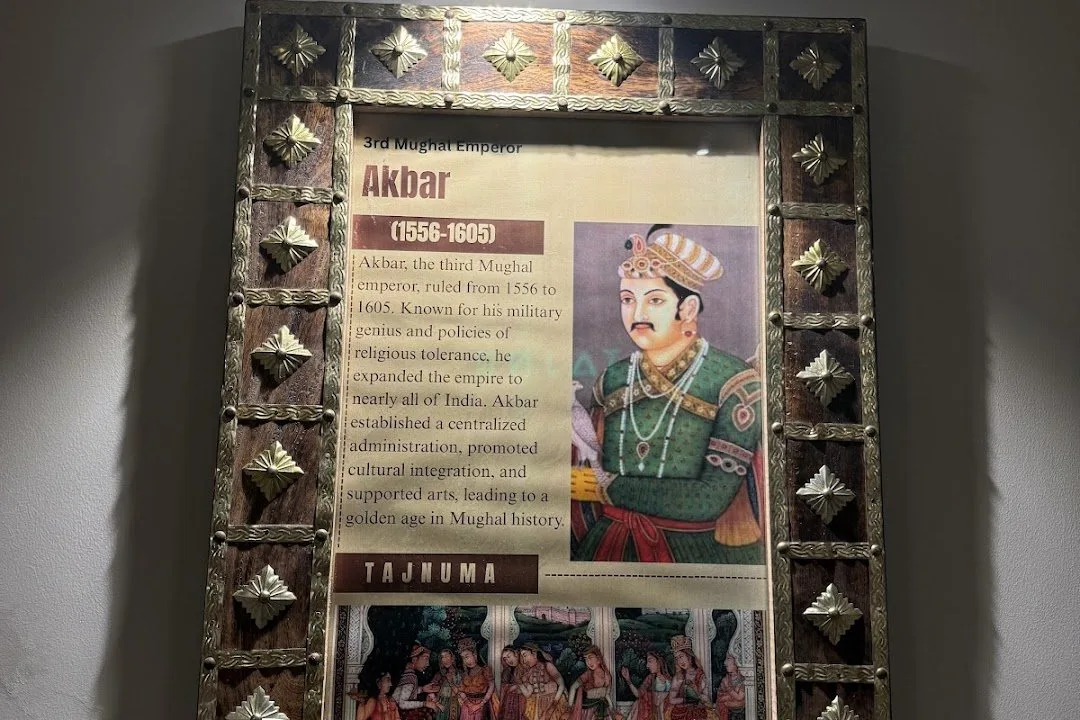
Akbar was buried at Sikandra, on the edge of the city, in a tomb begun in his lifetime and completed under Jahangir. It is a large, strange, striking building — red sandstone with marble inlay, tiered rather than domed, and quite unlike the Taj in temperament.
The grounds are extensive and full of deer and monkeys, and the gatehouse alone is worth the stop. It is on the Delhi side of the city, which makes it a natural first or last stop if you are driving in or out that way rather than a separate expedition.
Chini ka Rauza
The least visited thing on this list and the most likely to be entirely yours. A tomb on the same bank as Itimad-ud-Daulah, notable for its glazed tilework — chini meaning the china-like tiles that once covered it.
Much of that surface is gone and the building is worn, which is precisely the interest: it shows a decorative tradition that barely survives elsewhere in Agra, without restoration standing between you and it. Ten or fifteen minutes, easily combined with the Baby Taj since they are close together.
Agra Fort, Properly
Most one-day itineraries give Agra Fort an hour between the Taj and lunch, which is not enough. It is a walled city rather than a fort in the European sense — Akbar's red sandstone works, then the marble palaces Shah Jahan added inside them, and the rooms where he spent his last years under his son's confinement, looking downriver at the tomb he had built for his wife.
Give it two hours if you can. Seeing it after the Taj rather than before puts that last detail in the right order.
Building a Second Day
A workable second day: Sikandra early, when it is cool and empty. Back into the city for Chini ka Rauza and Itimad-ud-Daulah on the far bank, which sit close together. Lunch and a long pause through the worst of the afternoon. Mehtab Bagh for the late light.
If you only have half a day, take the far bank — the Baby Taj and Mehtab Bagh — and leave Sikandra for the drive out. Our one-day itinerary covers the compressed version, and the seasonal guide explains why the afternoon pause is not optional for much of the year.
Practical Notes
These are Archaeological Survey of India sites, and opening hours, ticket prices and closed days are set by the ASI and change. Check the official ASI ticketing site rather than trusting a figure from a blog, this one included. Note that Mehtab Bagh is not on the same ticket as the Taj Mahal, and that the Taj Mahal itself is closed on Fridays — a good day to do everything on this page.
Most of these sit apart from each other, on both sides of the river, so this is a day that needs transport arranged rather than improvised. Tajnuma is on Fatehabad Road in Tajganj, the hotel road on the Taj Mahal's side of the city, and we serve from 12:00 pm to 12:00 am if you want the afternoon pause somewhere cool.