Most of a Mughlai meal is eaten with bread, not with a fork. The gravies are made thick enough to be picked up, and the bread is the thing that picks them up. So the bread section of the menu, which visitors often skip over as a list of near-identical names, is worth two minutes. The names are not identical, and each one tells you how the bread was made.
In this article
Three Questions That Sort Every Bread
Almost every north Indian bread can be placed by asking three things. Is the dough leavened, or not? Is it baked in the tandoor, or cooked on a griddle? And is it a plain dough of flour and water, or one enriched with milk, ghee or sugar?
Roti is unleavened, plain, and usually made of whole wheat flour. Naan is leavened and made with refined flour, which is why it is softer and puffier. Paratha is layered with ghee. Sheermal is enriched with milk. Once you know the three questions, the rest of the list explains itself.
The Tandoor
A tandoor is a deep clay oven, shaped like a large jar, with the fire at the bottom. Bread is not placed on a shelf inside it. The shaped dough is pressed against the hot inner wall, where it sticks, cooks in a couple of minutes, and is lifted off with a pair of long iron rods.
That is what gives tandoori bread its character: one side blistered from the clay, the other browned by the heat of the fire, and a faint smokiness no home oven reproduces. The tandoor was in use in north India before the Mughals arrived; what their kitchens did was make it central. We have written about that meeting of traditions in From Persia to Agra.
What the Court Recorded
The Ain-i-Akbari, the record of Akbar's household compiled in the 1590s, has a short entry on bread. It distinguishes a large kind baked in an oven, made from a dough enriched with milk and ghee, from a thin kind baked on an iron plate, and it mentions chapati by name.
So the basic division on a modern menu — oven breads on one side, griddle breads on the other, plain doughs and rich ones — was already in place in the imperial kitchen more than four hundred years ago.
Naan and Khameeri
Naan is simply the Persian word for bread. In India it has come to mean one bread in particular: a leavened flatbread of refined flour, baked on the wall of the tandoor and usually brushed with butter or ghee as it comes out.
Khameeri comes from khamir, the word for leaven. A khameeri roti or khameeri naan is made from a dough that has been left to ferment, which gives it a slightly spongy crumb and a faint sourness. It is the bread most closely associated with the old Mughal cities, and it is at its best with a dal or a thick gravy.
Sheermal
Sheer is Persian for milk, and sheermal is a bread whose dough is made with milk rather than water, enriched with ghee and lightly sweetened. It is usually tinted and scented with saffron, and it is softer and richer than naan, closer to a pastry than to an everyday bread.
It is most strongly associated with Lucknow. There are stories about exactly who first baked it and for whom; they are good stories, and they are not documented, so treat them as such. What can be said is that it belongs to the enriched breads of the Persian tradition, and that it is eaten both with savoury dishes and as part of the sweet course.
Paratha and Roti
Paratha is the layered bread. The dough is rolled out, spread with ghee, folded or coiled, and rolled again, so that it cooks into flaky sheets. Laccha paratha is the version in which those layers are left visible as rings. It is traditionally a griddle bread, though many restaurants bake it in the tandoor.
Roti is the plainest bread on the table and the one eaten every day in north Indian homes: whole wheat flour, water, no leavening. A tandoori roti is the same dough baked on the oven wall. It is the lightest choice, and the one that gets out of the way of the food.
Which Bread to Order
A rough rule: the richer the dish, the plainer the bread. A heavily enriched gravy is better with roti or a plain naan than with a bread that is itself full of ghee. A dal can carry something with more character, and a khameeri naan is the classic partner. Sheermal, being slightly sweet, suits mild, creamy dishes and works at the end of the meal.
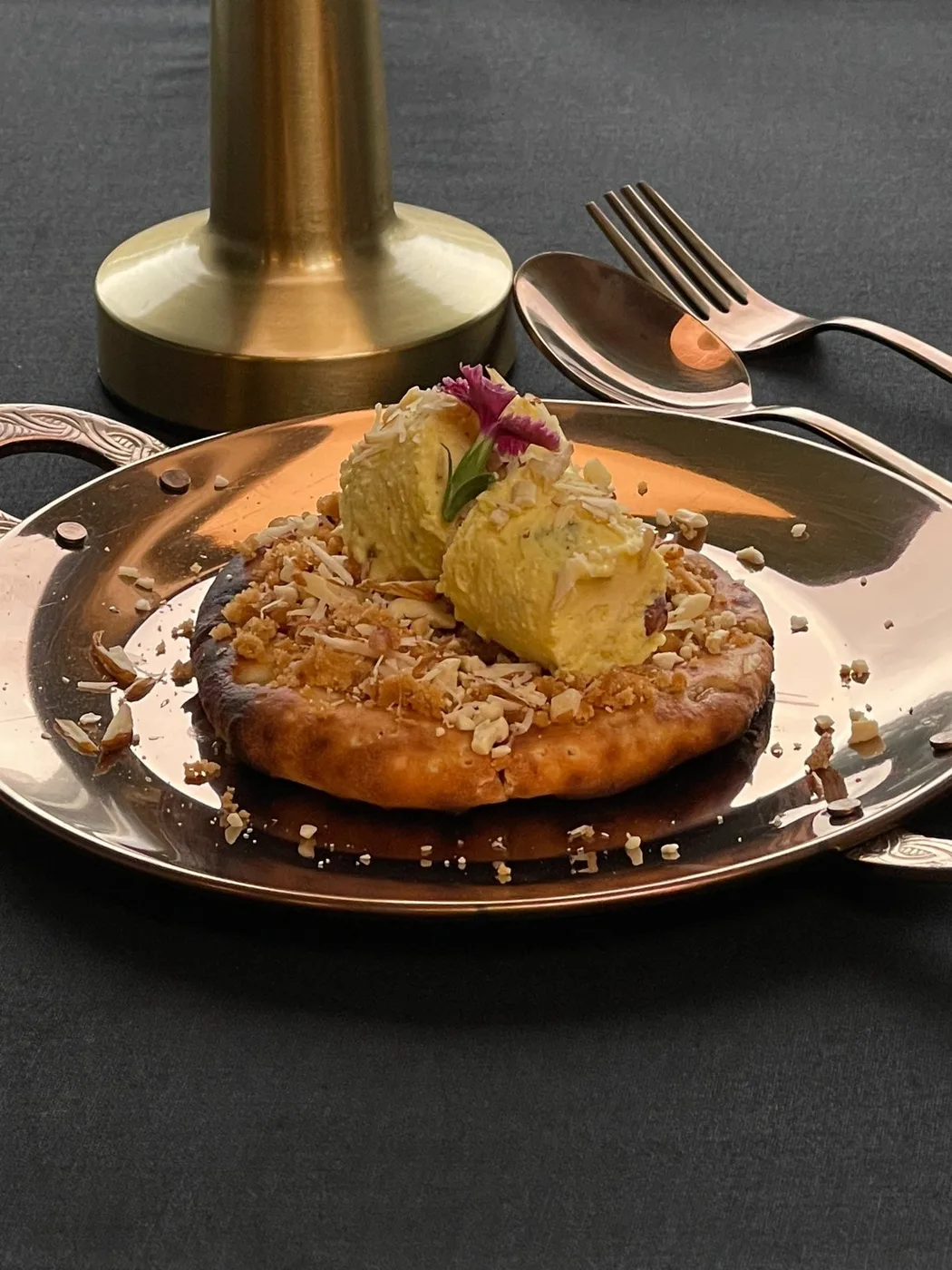
Our bread section is titled Nan-o-Roti and includes Tajnuma Khameeri Naan, Nawabi Naan, Sheermal Bread, plain and butter naan, and plain and butter roti. Mawa Sheermal with Malai Kulfi, on the dessert list, is the same bread taken to the sweet course. Bread is best ordered a little at a time so that it arrives hot; the guide to reading our menu covers the rest of the sections.